Roof Ventilation Problems in Raintree Village: A Field Guide
Roof ventilation is one of those systems you never think about until it fails, and then it shows up everywhere at once. You notice a warm upstairs bedroom in July, frost on the attic rafters in January, or dark streaks across the ceiling near an exterior wall. In Raintree Village, where summer humidity and winter freeze thaw cycles hit the same roof within a few months, a poorly ventilated attic ages shingles faster, inflates energy bills, and quietly feeds mold.
At Raintree Village Metal Roofing, we inspect dozens of attics every month, and ventilation issues show up in roughly half of the homes built before 2005. Sometimes the fix is a $400 baffle correction. Sometimes it is a full intake and exhaust redesign tied into a replacement. We treat this guide as a reference you can scan, not a sales pitch. If your roof does not need replacement, we will tell you. Founded in 2018 and holding BBB A+, Owens Corning Preferred, and Malarkey Certified status, our team has walked enough Raintree Village attics to know which symptoms are cosmetic and which ones are costing you shingles. Use the tables and checklists below to figure out where your home stands before you call anyone.
Quick Answer
Most roof ventilation problems in Raintree Village come from one of three causes: blocked soffit intake, insufficient ridge or gable exhaust, or mixing two exhaust types on the same roof plane. Symptoms include hot second floors, ice dams, musty attic air, and premature shingle curling. Fixes range from $150 baffle repairs to $1,200 ridge vent installs, and many are bundled into a roof replacement.
Ventilation Math: The 1/300 Rule
Code in central Indiana generally requires one square foot of net free vent area per 300 square feet of attic floor, split roughly half intake and half exhaust. A 1,600 square foot attic needs about 5.3 square feet total, or 2.65 at the soffits and 2.65 at the ridge.
Net free area is not the same as the physical opening. A 4 foot length of ridge vent might have only 72 square inches of actual airflow once the internal baffles and filter mesh are accounted for. Manufacturers print the net free area on the carton, and any honest estimate should show the math, not just a vent count.
Typical Fix Costs
| Repair | Range |
|---|---|
| Install soffit baffles (whole attic) | $300 to $700 |
| Cut and install new ridge vent | $600 to $1,200 |
| Add box vents (4 units) | $400 to $800 |
| Reroute bath fan through roof | $250 to $500 |
| Seal unused gable vents | $150 to $350 |
| Disconnect powered attic fan | $75 to $200 |
| Full ventilation redesign with roof replacement | Included in reroof |
What to Check Before You Call
- Stand on the street. Can you see ridge vent along the peak or only shingle caps?
- Look up at the soffits. Are the vent panels clear, or painted shut?
- In the attic, shine a flashlight at the eaves. You should see daylight between rafters.
- Touch the roof decking from inside. Damp, dark, or frosty means exhaust is failing.
- Check for a powered attic fan. If it runs in winter, it is pulling heated air out of your house.
- Look at the insulation depth at the outer walls. If it is piled higher than the top plate, it is likely blocking the soffit bays.
Warning Signs in Plain Language
| What You Notice | Likely Cause | Urgency |
|---|---|---|
| Upstairs 8 to 12 degrees warmer than main floor | Trapped attic heat, blocked intake | Moderate |
| Ice dams along eaves every winter | Warm attic melting snow unevenly | High |
| Frost on roof decking nails | Moisture from living space, poor exhaust | High |
| Shingles curling or blistering after 10 to 12 years | Attic temps above 150F | Moderate |
| Musty smell in closets on exterior walls | Mold growth in insulation | High |
| Mildew streaks on ceiling corners | Condensation cycling | Moderate |
How Ventilation Fails
Intake Problems
- Insulation stuffed into soffit cavities with no baffles
- Painted over soffit screens that clog with dust and spider webs
- Continuous soffit installed over solid wood blocking
- Homes with no soffit overhang at all, a common issue on older Raintree Village bungalows
- Vinyl soffit panels installed with the vented sections facing the wall instead of the open bay
Exhaust Problems
- Ridge vent nailed through its own baffle, blocking airflow
- Shingle over ridge vent with the cap slot never cut
- Box vents installed too low on the roof plane
- Bathroom fans terminated into the attic instead of through the roof
- Dryer vents routed through the soffit, dumping lint and humidity right back into the intake
That last one shows up more than you would expect. A ducted bath fan dumping moist air into a cold attic will frost the underside of the decking within one Indiana winter, which is a common trigger for the kind of roof leak detection and repair calls we get in February.
Why Powered Fans Backfire
Attic fans sound like a solution but usually make things worse. If soffit intake is inadequate, the fan pulls conditioned air from the living space through every ceiling penetration it can find: can lights, attic hatches, plumbing chases. You end up paying to cool air that gets blown straight out the roof. In winter, the same fan running on a humidistat will pull warm moist air up from bathrooms and kitchens and frost the decking. We recommend disconnecting them on nearly every home we inspect.
The Four Ventilation Systems You Will See in Raintree Village Homes
- Soffit and ridge: The modern standard. Cool air enters at the eaves, warm air exits at the peak.
- Soffit and gable: Common in 1980s and 1990s builds. Works adequately if gables are sized correctly.
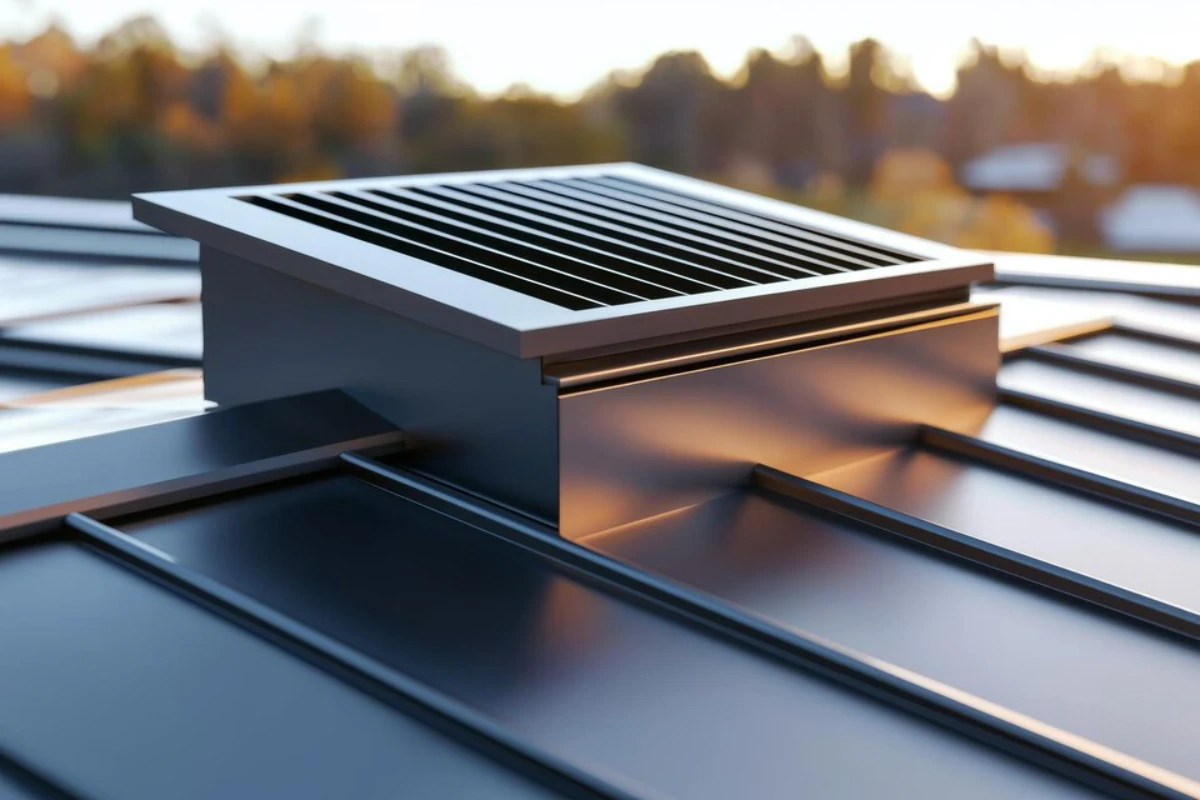
- Box vents (turtle vents): Passive static vents spaced across the upper roof field.
- Powered attic fans: Electric or solar fans that pull air. Often cause more problems than they solve.
Why Mixing Systems Causes Trouble
When a home has both a ridge vent and gable vents open, the ridge pulls air from the closer gable instead of from the soffits. The lower attic never flushes. We see this pattern in older Raintree Village neighborhoods where a ridge vent was added during a reroof but the original gable louvers were left in place. Sealing the gables usually solves it.
A similar short circuit happens when box vents and a ridge vent share the same roof plane. The ridge, sitting higher, pulls air from the nearest box vent rather than from the soffits six feet below. The top of the attic vents beautifully while the lower two thirds stagnates. Raintree Village Metal Roofing crews will typically cap the box vents during a reroof rather than leave two competing exhaust paths open.
Get a Real Look at What Your Attic Is Doing
Ventilation problems rarely announce themselves until the damage is expensive. The good news is that most of the Raintree Village attics we inspect can be fixed without a full replacement, and the ones that do need a new roof get one built to breathe correctly from day one. If your upstairs feels wrong, your shingles are aging early, or you just want a second opinion, reach out to Raintree Village Metal Roofing. We will climb into the attic, tell you what we see, and give you an honest path forward.
When Ventilation Ties Into Bigger Problems
Ventilation failures rarely stand alone. Ice dams, decking rot, and short shingle life all feed off the same root cause. If your roof is already past year 18 and showing curled shingles plus attic moisture, a repair may be throwing money at a system that needs replacement. We cover the tell tale indicators in our guide to the signs your roof needs replacement, which pairs well with this article. When Raintree Village Metal Roofing prices a reroof in Raintree Village, the ventilation redesign is built into the scope so you do not pay twice to solve the same problem.
Frequently Asked Questions
How do I know if my attic is actually under-ventilated?
In Raintree Village, the easiest signs are an upstairs that runs much hotter than the main floor, ice dams in winter, and shingles that curl or lose granules early. A quick attic check for frost, mold, or damp insulation confirms it.
Will more vents always fix the problem?
Not always. Adding exhaust without fixing intake can make things worse. Raintree Village Metal Roofing balances the intake and exhaust to the attic size so air actually moves from soffit to ridge instead of short circuiting.
Can ventilation issues void my shingle warranty?
Yes. Most manufacturers, including Owens Corning and Malarkey, require proper ventilation as a warranty condition. Shingles that cook from below age years faster and may not be covered if ventilation is inadequate.
Is a powered attic fan a good idea in Raintree Village?
Usually no. Passive ridge and soffit ventilation is more reliable, does not pull conditioned air from your living space, and has no motor to fail. We only recommend power fans in specific low-slope situations.
Do you charge for a ventilation inspection?
Raintree Village Metal Roofing offers free roof inspections in Raintree Village, and ventilation is part of every visit. You get a written assessment with photos, and if your roof does not need work, we will tell you that too.
Have a metal roofing question?
Our manufacturer-certified Raintree Village crew is ready to help. Free comprehensive inspections, written scopes, no pressure.